


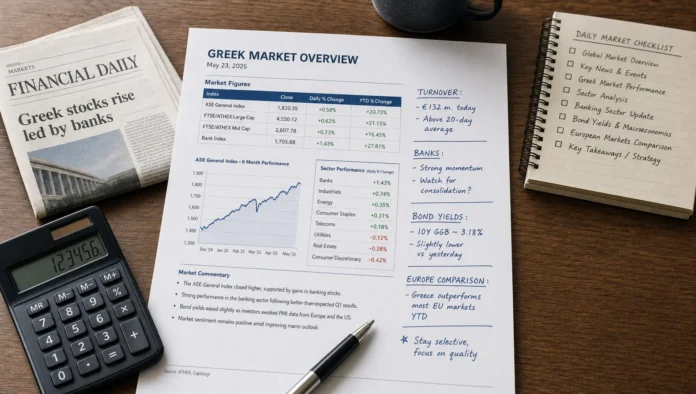
Opening a market page and seeing green or red numbers is easy. Reading what those numbers actually mean is harder. The Greek stock market today may be reacting to bank earnings, European interest-rate expectations, tourism data, bond yields, company announcements, or simply thin trading in a few large names.
A useful reading process turns the daily noise into a clear sequence of questions: What moved? Why did it move? Was the move broad or narrow? Does it change your investment thesis, or is it just market weather?
If you are new to Athens-listed shares, it helps to first understand the basic structure of the local market. Greek Shares has a separate primer on Greek stock market basics for long-term investors, but this guide focuses on the practical daily routine: how to interpret the market today without overreacting to every headline.
Start with the index, but do not stop there
Most investors begin with the main Athens market index because it gives a quick snapshot of direction. If the headline index is up, buyers are winning the day. If it is down, sellers have the upper hand. But that first glance can be misleading.
The Greek market is smaller and more concentrated than the largest global exchanges. A strong move in a handful of large banks, energy companies, or infrastructure names can pull the whole market higher even if many smaller shares are flat or falling. This is why reading the Greek stock market today requires looking beneath the index level.
Think in three layers:
| Layer | What to check | What it tells you |
|---|---|---|
| Market direction | Main Athens index and large-cap index | Whether broad investor sentiment is positive or negative |
| Sector leadership | Banks, energy, utilities, consumer, real estate, industrials | Which part of the economy is driving the move |
| Stock confirmation | Individual price moves, volume, announcements, and charts | Whether the move has a company-specific reason |
A market that is up 1% with strong participation across sectors sends a different message from a market that is up 1% because two large bank stocks rallied while most shares did nothing.
Know the key reference points
You do not need dozens of indicators to read the market effectively. A few reference points are enough to build a reliable daily picture.
The official Athens Exchange Group website is the natural starting point for market data, listed company announcements, trading calendars, and corporate actions. From there, investors can compare market action with macroeconomic data from the Bank of Greece and statistics from ELSTAT.
Here are the most useful signals to watch:
| Signal | How to read it | Why it matters |
|---|---|---|
| Main Athens index | Up, down, or flat versus previous close | Gives the broad daily direction |
| Large-cap index | Performance of the biggest listed companies | Shows institutional sentiment toward liquid Greek shares |
| Bank sector | Relative strength or weakness of major banks | Banks often influence the overall market tone |
| Turnover | Today’s trading value versus normal levels | Confirms whether a move has real participation |
| Advancers vs decliners | Number of stocks rising versus falling | Shows whether the move is broad or narrow |
| Greek government bond yields | Falling or rising yields | Reflects interest-rate expectations and country risk perception |
| European markets | Comparison with major eurozone indices | Helps separate local news from regional sentiment |
| Company announcements | Earnings, dividends, guidance, deals, regulatory updates | Explains stock-specific moves |
If you only check one thing beyond price, check turnover. A sharp price move on heavy trading often deserves more attention than a similar move on light volume.
Compare Greece with Europe before drawing conclusions
The Greek stock market does not trade in isolation. Greece is part of the euro area, and Athens-listed shares often respond to European Central Bank policy, eurozone growth expectations, commodity prices, and global risk appetite.
If Greek shares are falling while most European indices are also weak, the cause may be regional or global rather than Greek-specific. If Greece is rising while Europe is flat, you should look for local catalysts such as bank earnings, sovereign rating commentary, privatization news, tourism data, or corporate results.
A simple comparison can prevent a common mistake: blaming every move on local politics or local headlines. Sometimes the explanation is broader. A shift in European bond yields, a change in expectations for ECB rate policy, or weakness in global bank stocks can affect Athens even when there is no major domestic news.
Read sectors like economic clues
Sector performance is one of the fastest ways to understand the market’s message. Each major group reflects different expectations.
Banks are central because they are closely tied to credit growth, interest margins, asset quality, dividend expectations, and confidence in the domestic economy. If banks lead the market higher with strong turnover, investors may be expressing confidence in financial conditions or profitability. If banks drag the market lower, the market may be reacting to rate concerns, credit risk, or profit-taking after a strong run.
Energy and utilities often respond to commodity prices, regulation, investment plans, dividend expectations, and infrastructure themes. Consumer and retail names may reflect household income, tourism flows, inflation pressure, and spending trends. When evaluating retail or consumer-facing businesses, it can also help to look at how digital marketplaces shape customer expectations globally, from European platforms to regional examples such as Sandhai’s online shopping marketplace in the UAE, because convenience, product range, and delivery standards increasingly influence retail competition across markets.
Tourism-related and travel-sensitive businesses can move with expectations for arrivals, hotel demand, airport traffic, and consumer spending. Industrial and infrastructure names may react to project pipelines, energy costs, export demand, and public investment.
Be careful with shipping. Shipping is important to the Greek economy, but many Greek shipping companies are listed outside Athens. If a global shipping headline appears, ask whether it directly affects an Athens-listed company or only the broader economic story.
Use news as evidence, not entertainment
Market news is useful only when you can connect it to earnings, cash flow, risk, or valuation. Headlines that sound dramatic may have little effect on a company’s long-term value, while a quiet announcement about debt refinancing, regulation, or margins can matter much more.
When reading news, separate three categories:
- Market-wide news: ECB decisions, eurozone inflation, Greek bond yields, credit rating updates, government budgets, and geopolitical risk.
- Sector news: Bank regulation, energy prices, tourism data, construction activity, or consumer spending trends.
- Company news: Earnings, dividends, capital increases, mergers, contracts, management changes, and guidance.
Beginners often struggle because they read too many headlines and too few primary sources. For a more structured approach, Greek Shares explains how to separate signal from noise in its guide on how to read stock market news for beginners.
A good question to ask after every headline is: does this change expected profits, risk, or investor confidence? If the answer is no, the headline may not deserve much weight.
Confirm the story with charts and volume
Charts do not predict the future with certainty, but they help you see whether investors are confirming or rejecting a story. If positive news appears and the stock rises on strong volume, the market may be validating the news. If positive news appears and the stock fails to rise, expectations may already have been priced in.
For daily market reading, focus on a few simple chart concepts: trend, support, resistance, volume, and relative strength. You do not need complex indicators to understand whether a share is gaining momentum or losing it.
| Price action | Volume | Possible interpretation |
|---|---|---|
| Price rises | High volume | Buyers are showing conviction |
| Price rises | Low volume | Move may be fragile or technical |
| Price falls | High volume | Sellers may be reacting to meaningful news or risk |
| Price falls | Low volume | Could be routine volatility or lack of buyers |
| Price is flat | High volume | Buyers and sellers are actively disagreeing on value |
If you want to build confidence with the basics, Greek Shares has a practical guide on how to read stock charts clearly, including price, volume, trends, and support and resistance.

A practical 10-minute routine for reading the market
A repeatable routine prevents emotional decisions. Instead of jumping from headline to headline, follow the same process each time you check the Greek stock market today.
- Check the main index direction: Note whether the market is up, down, or flat, and compare the move with the previous day.
- Look at turnover: Decide whether today’s move is supported by meaningful trading activity or appears thin.
- Compare with Europe: See whether Athens is moving with or against broader European markets.
- Identify sector leaders and laggards: Pay special attention to banks, energy, utilities, consumer names, and industrials.
- Read official announcements: Check whether major movers released earnings, dividend news, corporate actions, or regulatory updates.
- Review charts of your watchlist: Look for breakouts, breakdowns, support tests, and unusually high volume.
- Ask whether your thesis changed: If nothing fundamental changed, avoid treating every daily price move as a decision signal.
This routine works because it moves from broad context to specific evidence. You start with the market, then sectors, then companies, then your own plan.
How to interpret common market scenarios
Daily market action becomes easier to read when you recognize patterns.
If the main index rises and banks lead on high turnover, the session likely reflects strong risk appetite toward liquid Greek shares. Investors may be responding to earnings, dividend expectations, improving bond sentiment, or positive macro news.
If the index rises but decliners outnumber advancers, the rally is narrow. This does not automatically make it weak, but it tells you that the headline index is not representing the whole market.
If the market falls while Greek bond yields rise, investors may be repricing interest-rate risk or country risk. This can affect banks, real estate, utilities, and highly leveraged companies.
If a stock falls on its ex-dividend date, the drop may be mechanical rather than negative. Many beginners misread dividend adjustments as sudden bad news. Always check the corporate calendar before reacting.
If a small-cap stock moves sharply on low volume with no announcement, be cautious. In less liquid shares, large percentage changes can happen with limited trading. Price alone is not proof of a meaningful change in value.
Match the daily reading to your time horizon
A trader, a long-term investor, and a beginner building financial literacy should not interpret the same daily move in the same way.
A short-term trader may care about intraday momentum, liquidity, spreads, and technical levels. A long-term investor should care more about valuation, earnings quality, dividends, balance sheets, and whether the company’s competitive position is improving. A beginner should focus on learning the relationship between news, price, volume, and risk.
For long-term investors, the most important daily question is not “Should I buy or sell today?” It is “Did today’s information change the reason I own or follow this company?”
This distinction protects you from overtrading. Markets move every day, but genuine investment theses change less often.
Build a watchlist instead of chasing every mover
A watchlist is one of the best tools for reading the market calmly. Choose a manageable group of Athens-listed shares, sector indices, and macro indicators. Track them consistently. Over time, you will understand how they behave during earnings season, ECB meetings, bond market moves, and periods of global volatility.
Your watchlist might include:
- A broad Athens market index for direction.
- A large-cap benchmark for institutional sentiment.
- A bank index or leading bank shares for financial-sector tone.
- A few companies from sectors you understand.
- Greek government bond yields and major European indices for context.
Keep notes. Write down why a stock moved, whether the explanation was company-specific or market-wide, and whether volume confirmed the move. After a few months, this journal becomes more valuable than random commentary because it trains you to observe patterns without panic.
Common mistakes to avoid
The first mistake is reading the Greek market only through the main index. The index is useful, but it can hide weak breadth or sector concentration.
The second mistake is ignoring liquidity. In smaller markets, price moves can look more dramatic when trading volume is thin. Always ask whether enough shares traded to make the move meaningful.
The third mistake is treating every headline as equally important. An earnings update, dividend announcement, or regulatory change usually matters more than vague commentary.
The fourth mistake is forgetting the European context. Greek shares may move because of ECB expectations, eurozone bank sentiment, or global risk appetite, not only because of domestic news.
The fifth mistake is reacting without a plan. If you do not know your time horizon, risk tolerance, and reason for following a stock, today’s price movement can easily push you into emotional decisions.
A simple daily template
Use this quick template whenever you review the market:
| Question | What to write down | Why it helps |
|---|---|---|
| What did the market do? | Index direction and percentage move | Establishes the basic tone |
| Was the move broad? | Advancers, decliners, and sector leadership | Shows market participation |
| Was volume strong? | Turnover versus normal activity | Confirms or weakens the signal |
| What news mattered? | Official announcements and macro events | Connects price to evidence |
| What did bonds and Europe do? | Greek yields and European indices | Adds regional context |
| Did my thesis change? | Yes, no, or needs research | Prevents emotional trading |
The goal is not to predict every short-term move. The goal is to understand what the market is saying and decide whether that message is relevant to your strategy.
Frequently Asked Questions
What is the best way to check the Greek stock market today? Start with the main Athens index, then check sector performance, turnover, company announcements, Greek bond yields, and European market direction. This gives a fuller picture than price alone.
Which Greek stock market index should beginners follow? Beginners can start with the main Athens market index and a large-cap index, then add sector references such as banks as they learn. The key is to understand what each index represents and which companies drive it.
Why do banks matter so much in the Greek market? Banks are major listed companies and are closely tied to credit conditions, interest rates, asset quality, and economic confidence. Their movements often influence the tone of the broader market.
How important is trading volume? Volume is very important because it helps confirm whether a move has conviction. A large price move on high volume usually carries more information than the same move on very light trading.
Does the Greek stock market follow European markets? Often, yes. Greece is part of the euro area, so ECB policy, eurozone investor sentiment, bond yields, and global risk appetite can affect Athens-listed shares.
Should long-term investors react to daily market moves? Usually not unless the move reflects new information that changes the investment thesis. Long-term investors should use daily market action as information, not as an automatic buy or sell signal.
Reading the Greek market well is a skill built through repetition. Start with the broad index, move into sectors, verify with news and volume, and always connect the day’s action back to your own investment goals. Greek Shares exists to help investors build that kind of financial literacy step by step, from beginner concepts to more advanced market interpretation.