


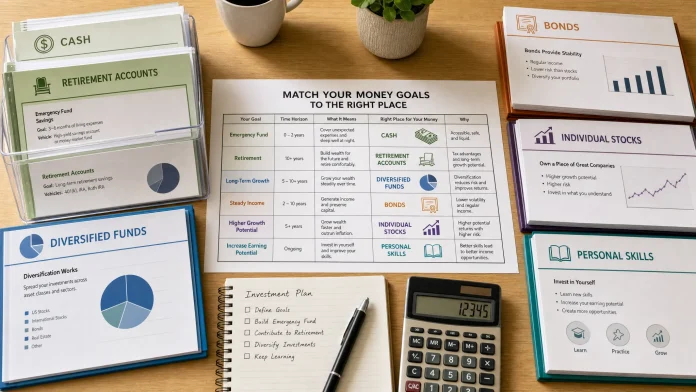
The hardest part of beginning is not finding an investment. It is choosing the right place for your money based on what that money is supposed to do.
A beginner often asks, “Where can I invest?” A better question is, “When will I need this money, and how much uncertainty can I handle along the way?” Money for next month’s rent does not belong in the same place as money for retirement. Money you are using to learn about markets should not be treated the same as your emergency fund.
This guide walks through the main places you can invest when you are just starting out, from safer cash options to stock market funds, bonds, individual stocks, and even your own skills. It is educational, not personal financial advice, but it will help you build a clearer first investing roadmap.
First, separate “where” into accounts and investments
Beginners often mix up two different decisions: the account you use and the investment you buy inside it.
An account is the container. Examples include a brokerage account, retirement account, savings account, or workplace investing plan. An investment is what you hold inside the container. Examples include stocks, ETFs, mutual funds, bonds, or cash.
This distinction matters because a great investment in the wrong account can create tax, access, or risk problems. Likewise, opening an account is not enough if the cash inside never gets invested.
A simple way to think about it is this:
| Your goal | Possible place for the money | Why it may fit beginners |
|---|---|---|
| Emergency fund or near-term spending | High-yield savings, insured bank account, money market fund, short-term CDs | Prioritizes access and stability over high returns |
| Retirement or long-term wealth | Retirement account or taxable brokerage account with diversified funds | Gives time for compounding and market growth |
| Learning about stocks | Small brokerage allocation for individual stocks | Lets you practice research without risking your whole plan |
| Reducing portfolio swings | Bonds, bond funds, Treasury securities | Can add income and balance to a stock-heavy portfolio |
| Growing income potential | Education, certifications, tools, business systems | May improve your ability to earn and invest more later |
Before choosing any option, make sure you have a basic plan. If you are still unsure how to build that plan, Greek Shares has a helpful guide on how to start investing without guesswork that explains goals, mindset, and a simple beginner process.
1. Start with cash for money you need soon
Cash is not exciting, but it is often the first “investment” a beginner should make. If you do not have an emergency fund, a job loss, medical bill, car repair, or family expense can force you to sell investments at the worst possible time.
For money you may need within the next 6 to 24 months, safety and access usually matter more than return. Common options include high-yield savings accounts, insured bank accounts, short-term certificates of deposit, Treasury bills, and money market funds.
In the United States, the FDIC explains deposit insurance for eligible bank deposits, generally up to standard limits. If you live outside the U.S., check your own country’s deposit protection rules before assuming your cash is protected.
Cash will not usually build long-term wealth after inflation. Its job is different. It protects your plan so you do not need to interrupt your long-term investments during a difficult month.
2. Use retirement accounts when the goal is long-term wealth
If you are investing for retirement, tax-advantaged accounts can be one of the best places to start. Depending on your country and employment situation, these may include workplace retirement plans, individual retirement accounts, pensions, or other long-term savings structures.
The main advantage is not that these accounts magically remove risk. The advantage is that they may offer tax benefits, employer contributions, automatic investing, or restrictions that keep you from spending long-term money too early.
If your employer offers a matching contribution, it is worth understanding carefully. A match can be one of the clearest benefits available to a new investor because it adds money to your account when you contribute according to the plan’s rules.
The key beginner lesson is simple: retirement money should usually be invested for decades, not weeks. That longer time horizon can make diversified stock and bond funds more appropriate than short-term cash, provided you can tolerate market ups and downs.
3. Consider broad index funds and ETFs as a beginner core
For many beginners, diversified index funds or exchange-traded funds, known as ETFs, are easier to manage than picking individual stocks. A single broad fund can give you exposure to hundreds or thousands of companies.
Instead of trying to guess which company will win next year, an index fund lets you participate in a wider market. Examples include funds that track large U.S. companies, total stock markets, global stocks, or a mix of stocks and bonds.
This approach has two big beginner advantages. First, it reduces the damage that one bad company decision can do to your portfolio. Second, it gives you time to learn without needing to make constant trading decisions.
Diversification does not guarantee profit or prevent loss, but it can help manage risk. The SEC’s Investor.gov resource on asset allocation explains how investors spread money across different asset types based on goals, risk tolerance, and time horizon.
If you want to go deeper into stock market basics, Greek Shares also has a practical article on investing in stocks with a simple starter plan, including readiness checks and portfolio-building ideas.
4. Add bonds when you need balance, income, or lower volatility
Bonds are loans made to governments, municipalities, or companies. In return, the borrower generally pays interest and repays principal according to the bond’s terms. Beginners can access bonds directly in some cases, or indirectly through bond mutual funds and bond ETFs.
Bonds are often described as safer than stocks, but that does not mean they are risk-free. Bond prices can fall when interest rates rise. Lower-quality bonds can default. Bond funds can fluctuate every day.
Still, bonds can play an important role. They may reduce the overall swings of a portfolio, provide income, and help investors avoid putting every dollar into stocks. A young investor with a long time horizon may hold more stocks, while someone investing for a nearer goal may prefer a more balanced mix.

5. Buy individual stocks only with a limited learning allocation
Individual stocks are often what people imagine first when they hear the word investing. Buying shares in a company can be exciting because you become a partial owner of that business.
The problem is that excitement can lead beginners to put too much money into one idea. A company can look strong and still disappoint. A popular stock can be overpriced. A great product does not always mean a great investment.
That does not mean beginners must avoid individual stocks forever. A sensible approach is to treat them as a learning allocation, not the foundation of your financial future. For example, you might build the core of your portfolio with diversified funds, then use a smaller percentage to study and buy individual companies.
When researching a stock, focus on the business, not just the price chart. Ask how the company earns money, whether profits are growing, how much debt it has, who its competitors are, and whether the valuation makes sense. If you cannot explain why you own it, you probably are not ready to buy much of it.
6. Use robo-advisors or managed portfolios if you want help
Some beginners do not want to choose funds, rebalance accounts, or decide how much to hold in stocks versus bonds. In that case, a robo-advisor or managed portfolio may be worth considering.
These services typically ask questions about your goals, time horizon, and risk tolerance, then suggest a diversified portfolio. Some also rebalance automatically or adjust the allocation as you get closer to a goal.
The trade-off is cost and control. You may pay advisory fees, and you may have less flexibility than managing everything yourself. Still, for someone who would otherwise leave cash uninvested for years, a simple managed solution can be better than waiting for perfect knowledge.
Before using any platform, understand the fees, investment choices, withdrawal rules, and whether the provider is regulated in your jurisdiction.
7. Invest in your ability to earn more
Not every investment has a ticker symbol. When you are just starting out, one of the most powerful places you can invest is in your own earning capacity.
This could mean learning a high-value skill, improving your language ability, earning a professional certification, taking a course, building a small business, or buying tools that save time and reduce costly mistakes.
For business owners, better financial systems can also be an investment. For example, a travel agency that improves payment management, fraud prevention, and reconciliation may free up time and cash flow for growth. In that specific industry, an all-in-one payment platform for travel agencies can be relevant because operational efficiency affects how much money a business can eventually save and invest.
The reason this category matters is simple: your savings rate depends on the gap between what you earn and what you spend. A higher income, combined with disciplined spending, can make every investment account more powerful.
8. Approach real estate carefully as a beginner
Real estate is another place beginners often want to invest. It can build wealth, but it is not always simple or passive.
Buying property directly can involve a down payment, debt, maintenance, taxes, insurance, vacancies, tenant issues, and local market risk. If you are not prepared for those responsibilities, real estate can become a stressful second job.
A more accessible option may be real estate investment trusts, or REITs. These are companies that own or finance income-producing real estate, and many trade like stocks. REITs can provide exposure to real estate without buying a property yourself, though they still carry market risk and can fall in value.
Real estate can be useful, but beginners should avoid rushing into it just because someone online calls it “passive income.” The numbers, financing terms, and risks matter.
What beginners should usually avoid at first
Some investing areas are better left until you have experience, a stable foundation, and a clear risk management process. The problem is not that advanced tools are always bad. The problem is that they can magnify beginner mistakes.
Be especially careful with:
- Margin borrowing, because it can amplify losses and force you to sell.
- Short-term trading, because costs, taxes, emotion, and timing errors can add up.
- Options and complex derivatives, because they require specialized knowledge.
- Concentrated crypto speculation, because volatility can be extreme.
- Private deals you do not fully understand, because liquidity and transparency may be limited.
If an investment promises high returns with little or no risk, slow down. Risk is never eliminated. It is only transferred, hidden, delayed, or misunderstood.
A simple starter plan for your first 90 days
You do not need to solve your entire financial life immediately. A beginner can make real progress by building a repeatable process.
| Time period | Main action | What success looks like |
|---|---|---|
| Days 1 to 30 | Build your foundation | List debts, expenses, emergency savings, goals, and available monthly investing amount |
| Days 31 to 60 | Choose your account and core investment | Open a suitable account and identify a diversified fund or portfolio approach |
| Days 61 to 90 | Automate and review | Set a recurring contribution, track fees, and write down why you chose your allocation |
The amount you start with matters less than the habit. A beginner investing a modest amount consistently can learn faster and avoid the pressure of making one huge decision. If you need help setting a realistic contribution, read Greek Shares’ guide on how much beginners should invest per month.
The main goal of your first 90 days is not to become an expert. It is to stop being stuck. Once your system exists, you can improve it over time.
How to choose the right place for your first investment
If you are still unsure where to start, match the investment to the job of the money.
Money needed soon belongs in stable, accessible places. Money for long-term wealth can usually accept more volatility. Money for learning can be smaller and more experimental. Money for your career or business should be judged by whether it helps you earn, save, or operate better.
A beginner-friendly decision rule is this: do not invest in anything you cannot explain in plain English. If you cannot describe how it makes money, what could go wrong, what fees you pay, and when you need the cash back, you need more research before committing.
Also, avoid comparing your beginning to someone else’s middle. A person with a large portfolio, high income, and years of experience can take risks that may be inappropriate for you. Your first job is to build a durable base.
Frequently Asked Questions
Where can I invest with a small amount of money? You can usually start with savings accounts, brokerage accounts, fractional shares, ETFs, mutual funds with low minimums, or retirement accounts that allow small recurring contributions. Availability depends on your country, broker, and account type.
Should beginners invest in stocks or ETFs first? Many beginners prefer ETFs or index funds first because they offer diversification in one purchase. Individual stocks can be useful for learning, but they usually require more research and carry more company-specific risk.
Is it better to pay off debt or invest? High-interest debt can be more urgent than investing because the interest cost may exceed realistic investment returns. Lower-interest debt depends on your goals, cash flow, and risk tolerance. This is one area where personal circumstances matter a lot.
How much money should I keep in cash before investing? Many people aim for an emergency fund that can cover several months of essential expenses, but the right amount depends on job stability, family responsibilities, insurance, and access to credit. The more uncertain your income, the more valuable cash can be.
Can I lose money with beginner investments? Yes. Any investment tied to markets can lose value, including ETFs, stocks, bonds, bond funds, and REITs. The goal is not to avoid all risk. The goal is to take risks you understand and can afford.
Start simple, then build confidence
When you are just starting out, the best place to invest is usually not the most exciting place. It is the place that matches your goal, protects your downside, and helps you stay consistent.
Begin with financial stability. Use the right account. Build a diversified core. Keep individual stock picking small until your skill improves. Consider bonds for balance. Invest in your earning power. Most importantly, keep learning before increasing complexity.
A strong investing life is built one clear decision at a time. You do not need to know everything today. You only need a sensible first step and the patience to keep improving it.